
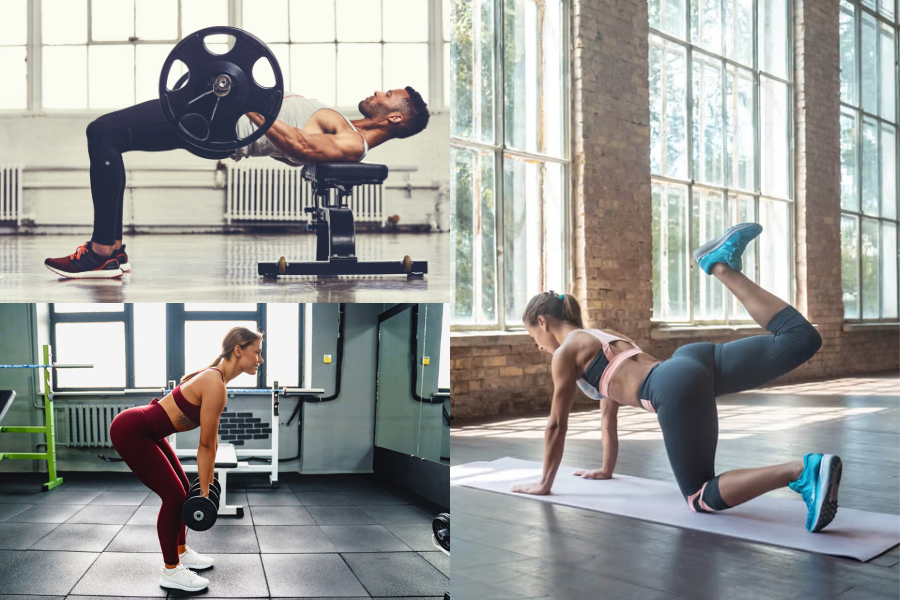
Whether you want a stronger lower body, better posture, or a more defined physique, the best glute exercises can make all the difference. Your glutes are among the largest and most powerful muscles in your body. When you train them effectively, you boost everyday performance, from climbing stairs to lifting heavy boxes, and reduce your risk of back or hip pain. Below, you will find a practical breakdown of why your glutes matter, how to warm up for success, and how to integrate ten tried-and-true movements into your workout routine. Each suggestion is backed by research from leading fitness resources so you can train with confidence.
Understand the glute muscles
Your glutes consist of three primary muscles: the gluteus maximus, medius, and minimus. Each one plays a distinct role in your movement and stability.
- Gluteus maximus. As the largest muscle in your glutes, it powers hip extension, helping you stand up from a chair or climb a hill.
- Gluteus medius. Found on the outer side of your hip, this muscle supports hip abduction and rotation, which stabilizes your pelvis when you run or walk.
- Gluteus minimus. Located directly under the gluteus medius, this smaller muscle assists with hip stabilization, balance, and rotation.
According to a July 2025 guide by Planet Fitness, working all three glute muscles is essential for overall strength, stability, and athletic performance [1]. A 2024 Cleveland Clinic overview also emphasizes how your glutes support your lower back and pelvis to reduce injury risk [2]. If you keep each region of the glutes engaged, you set the foundation for more fluid movement and safer workouts.
Warm up effectively
Before diving into your glute exercises, devote at least 10 minutes to warming up with light or moderate cardio. Healthline recommends simple moves like power walking or easy jogging to get your heart rate up and mobilize your hips before heavier work [3]. This approach revs your circulation and preps the muscles for the focused exercises to come.
In addition, brief glute activation drills can also prime your body. Peloton instructors often suggest exercises such as mini hip bridges, bodyweight squats, or standing leg lifts for a few reps before the main workout [4]. These drills fire up the neuromuscular connections in your glutes, ensuring you feel each rep more effectively when you move on to targeted strength work.
Perform these 10 exercises
In this section, you will discover ten best glute exercises that are often recommended by fitness experts. You can do most of them at home with no or minimal equipment. If you have access to resistance bands, barbells, or dumbbells, you can gradually increase resistance once your form feels solid.
1. Bodyweight squats
Bodyweight squats are a time-tested classic for glute growth. If you have never done squats, this is the perfect place to start.
- Stand with feet shoulder-width apart.
- Bend your knees and push your hips back, as if sitting into a chair.
- Keep your spine neutral and your abdominal muscles tight.
- Lower yourself until your thighs are near parallel to the floor.
- Push through your heels to return upright.
A 2024 Healthline article calls squats a “gold-standard” glute exercise when performed slowly and with controlled form [3]. If you want more intensity, try adding a pause at the bottom or hold light weights if you have them. This incremental challenge can reinforce progressive overload and spark quicker results.
2. Hip thrusts
Hip thrusts target the gluteus maximus through a deep range of motion. You can do them with a bench, your couch, or even on the floor using a variation known as a glute bridge.
- Sit on the floor with your upper back against a bench.
- Bend your knees and place your feet flat on the ground.
- Rest your arms on the bench for support.
- Drive your hips upward by pushing through your heels, squeezing your glutes at the top.
- Lower slowly and repeat.
This move focuses primarily on the gluteus maximus, but it also engages your gluteus medius and minimus to stabilize your hips. According to Cleveland Clinic, hip thrusts deliver significant gains in glute strength and are crucial for comprehensive lower-body stability [2]. When you feel comfortable, add weight across your hips (such as a barbell or dumbbell) to challenge those muscles further.
3. Curtsy lunges
Curtsy lunges are more than just a fancy twist on a regular lunge. This move recruites the gluteus medius and minimus because of the crossover motion behind your body.
- Stand with feet hip-width apart.
- Step your right foot behind and across your left leg, as if curtsying.
- Bend both knees until your left thigh is nearly parallel to the floor.
- Push through your left heel to return to standing, then switch sides.
Fitness coaches from ATHLEAN-X recommend curtsy lunges for targeting the lateral glute muscles and increasing hip stabilization [5]. Keep your torso upright and your stance central so the tension stays in the side glutes, not in your lower back.
4. Bulgarian split squats
Bulgarian split squats challenge your balance and unload your spine while deeply working your glutes, quads, and hamstrings. You need a stable chair, bench, or step behind you.
- Stand a few feet in front of a bench.
- Place the top of your right foot on the bench behind you.
- Bend your left knee, lowering your body straight down.
- Push through your left heel to come back up.
According to Gymshark, single-leg exercises like Bulgarian split squats keep each side of your body honest in terms of effort and form [6]. If you are new to this exercise, focus on stability; hold a wall or chair for light support until you master the coordinated movement.
5. Donkey kicks
Donkey kicks isolate the glutes without much upper-body stress. You do not need fancy equipment—just enough space on the floor to work comfortably.
- Kneel on all fours with your hands under your shoulders and knees under your hips.
- Keep your right knee bent at a 90-degree angle.
- Lift your right foot straight up, kicking the sole of your foot toward the ceiling.
- Squeeze your glutes, then lower your knee with control.
- Switch legs after finishing your set.
Cleveland Clinic highlights donkey kicks as a good way to isolate the gluteus maximus [2]. Perform them slowly so you engage the targeted area. Go for a moderate rep range, usually 10 to 12 reps per side, to keep the muscle under tension.
6. Fire hydrants
Fire hydrants strengthen the smaller glute muscles (especially the medius and minimus) that help with side-to-side motion and balance. Similar to donkey kicks, the setup uses your hands and knees on the floor.
- Start in a tabletop position, hands under shoulders, knees under hips.
- Keep your right knee bent as you lift it outward to the side, opening your hip.
- Avoid twisting your torso or leaning away from the raised leg.
- Bring your knee down slowly, returning to the starting position.
Health experts at Cleveland Clinic warn that fire hydrants can get tiring quickly, so maintain proper form to avoid your back doing the work instead of your glutes [2]. This move improves hip stability and may reduce knee strain when you walk or climb stairs.
7. Single-leg deadlifts
A single-leg deadlift is another unilateral exercise that fosters balance and head-to-toe stability. It works your hamstrings and glutes in tandem.
- Stand on your right leg with the left foot slightly behind you.
- Hinge forward at your hips, keeping your back neutral.
- Let your left leg extend behind as your torso moves forward.
- Squeeze your right glute to return upright, lifting your torso and lowering your left leg.
Research cited by Peloton shows that single-leg work can amplify activation in the gluteus medius and minimus because they help you stabilize and maintain balance on one leg [4]. If controlling the movement is challenging, place your fingertips on a wall or hold a light weight in your opposite hand for extra help.
8. Step-ups
Step-ups are an excellent bridge between bodyweight squats and more advanced single-leg moves. You will need a sturdy platform or bench about knee height.
- Stand in front of the platform with your feet hip-width apart.
- Step your right foot fully onto the platform.
- Drive through your right heel and straighten your leg to lift your body onto the platform.
- Carefully step down with the left foot, returning to the ground.
- Repeat on the same side or alternate legs each rep.
Peloton trainers list step-ups among their top glute activation drills thanks to the targeted engagement of all three glute muscles [4]. Make sure you do not bounce off your back foot. Instead, rely on your front leg to push your body up.
9. Banded lateral walks
Banded lateral walks (or lateral band walks) put a challenging spin on simple side steps by using a looped resistance band around your thighs, ankles, or feet.
- Place a resistance band around your ankles (or just above your knees if that feels more comfortable).
- Stand with feet hip-width apart and knees slightly bent.
- Step your right foot sideways, stretching the band.
- Bring your left foot in, maintaining tension in the band.
- Continue in one direction for the desired number of steps, then reverse.
Known for hitting the gluteus medius specifically, these walks also keep the gluteus maximus and minimus engaged. Peloton experts note that placing the band at the ankles can increase muscle activation [4]. Keep your knees from caving inward and focus on precise, controlled steps.
10. Clamshells
If you prefer to train lying on your side, clamshells deliver a noticeable burn in the outer glutes and hips.
- Lie on your side with your knees bent at about a 45-degree angle, hips stacked.
- Keep your feet together as you lift your top knee upward without shifting your pelvis.
- Pause briefly when you feel the tension in your outer hip.
- Lower your knee slowly to the starting position.
- Switch sides after finishing your reps.
This movement appears in many beginner-friendly programs, including those by Healthline and Planet Fitness [7]. Focus on slow, controlled knee lifts for the best glute engagement. If you want something more advanced, add a small looped resistance band around your thighs.
Optimize your training
Now that you have a sense of these ten best glute exercises, your next goal is to structure them in a way that supports muscle growth and avoids overtraining. According to multiple sources, including Planet Fitness, performing glute workouts two to three times per week is ideal for beginners. Here are a few considerations to help you get the most out of each session.
Frequency and rest
- Train two to three days per week. Beginners can see noticeable glute development within six weeks of consistent training when sessions are spaced out for recovery [6].
- Take at least one day off between glute-focused workouts. Recovery is critical for muscle repair and growth. Overtraining can stall progress and lead to injuries.
Progressive overload
- Increase reps when bodyweight moves become too easy. Simply adding three or four more reps each week can jump-start further gains.
- Slow down your tempo. Decreasing speed amplifies the time your muscle spends under tension. For instance, take two or three counts to lower yourself in a squat before powering back up.
- Reduce rest periods. Shortening rest encourages your glutes to work under greater fatigue, igniting new improvements.
- Add resistance bands or light weights. A band around your thighs during a glute bridge or donkey kick can significantly boost intensity.
- Transition to heavier equipment. Once you feel that bodyweight exercises no longer yield progress, consider using barbells, heavier dumbbells, or even kettlebells to keep challenging your glutes.
Combine activation and strength
Peloton trainers emphasize glute activation drills before a more strenuous session—for example, you might do a short set of fire hydrants or clamshells right before heavy hip thrusts [4]. This approach helps wake up your entire glute complex so you recruit the correct muscles when doing bigger lifts. If your glutes are “sleepy,” you risk letting the quads or back take over.
Don’t skip mobility
Keeping your hips flexible and your lower back limber is equally vital. A 2025 Planet Fitness beginner glute workout guide suggests stretching your hip flexors after each session, plus foam rolling your IT band to release tension [1]. These simple habits can help you squat, lunge, and hinge deeper without straining related joints.
Prioritize nutrition
Although this article primarily covers exercise techniques, remember that balanced nutrition underpins all muscular development. Adequate protein supports muscle repair. Enough calories foster growth. Incorporating nutrient-dense foods—lean protein sources, whole grains, fruits, and vegetables—helps round out your training, providing the fuel your body needs to strengthen your glutes.
Review your progress
Consistency is your ally when it comes to glute gains. If you work your glutes two to three times a week, stick with it for at least one or two months to start seeing results [3]. Document your journey by noting your sets, reps, and how each exercise feels. For instance, you might write down details like:
- Which exercises felt strongest or weakest.
- The last weight or band tension you used.
- Any improvements in form or balance.
Tracking progress reveals patterns. If you plateau, adjust one training variable—maybe add a new movement like the single-leg deadlift, or increase the load you use for hip thrusts. After another few weeks, re-evaluate. You might discover that you have greater squat depth, improved posture, or more explosive power during other workouts.
Remember, exercising your glutes is not just about aesthetics. Strong, well-balanced glutes help you master daily tasks, maintain proper posture, and enhance athletic pursuits. By curating a plan with progressive overload, focusing on proper form, and balancing rest with effort, you can unlock your full lower-body potential.
Take a quick look at the core steps:
- Warm up with light cardio and activation drills.
- Perform foundational moves like squats, hip thrusts, and lunges.
- Add single-leg and lateral exercises for well-rounded strength.
- Gradually increase resistance and vary your approach.
- Stick to consistent training two to three times per week.
Use these best glute exercises as your roadmap to a stronger, more resilient lower body. With each session, you will notice improvements in stability, posture, and power—benefits that extend into everyday life. Above all, remember that slow, deliberate progress is the surest way to build a solid foundation for long-term success.
References
- (Planet Fitness)
- (Cleveland Clinic)
- (Healthline)
- (Peloton)
- (ATHLEAN-X)
- (Gymshark)
- (Healthline, Planet Fitness)