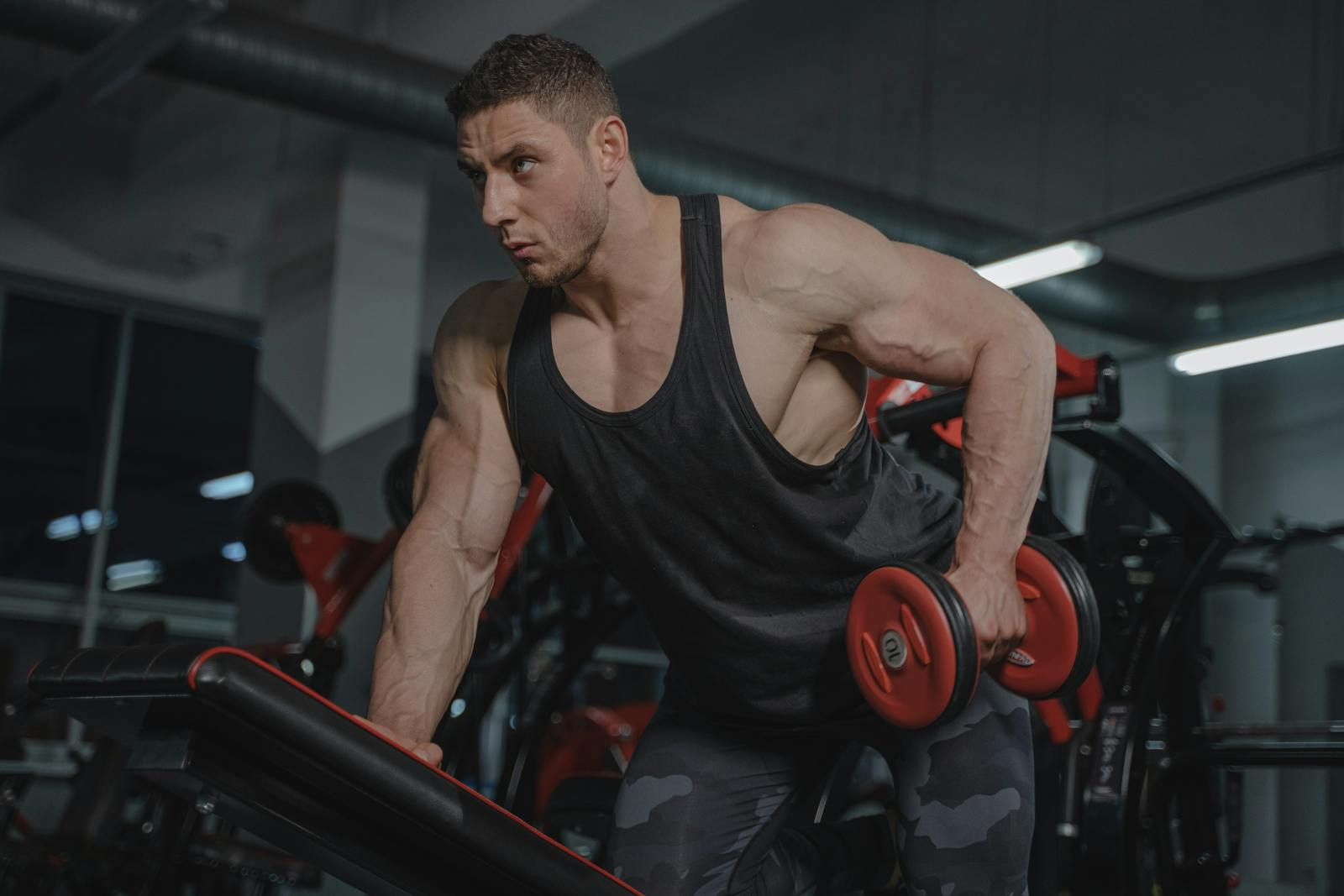
Understand why single arm tricep exercises matter
If you want stronger, more defined arms, single arm tricep exercises belong in your routine. Training one side at a time helps you spot and correct muscle imbalances, build better control, and fully engage all three heads of your triceps, especially the long head that supports upper arm size and stability.
When you rely only on machines or cable pushdowns, your range of motion can be limited and other muscles often take over. Free weight moves like one-arm dumbbell extensions and kickbacks let your shoulder and elbow move more naturally so you can feel the triceps doing the work instead of your joints.
Single arm work is also practical. You only need one dumbbell or a band, so you can train at home, at the gym, or in a tight space without a lot of equipment.
Know your triceps and how they work
Before you pick up a dumbbell, it helps to understand what you are trying to train.
Your triceps have three heads:
- Long head
- Lateral head
- Medial head
The long head crosses your shoulder joint, so it responds especially well to overhead movements. If you never train the long head through a full stretch and squeeze, you can end up with:
- Flat looking arms even if you work them often
- Shoulder or elbow discomfort from overusing other muscles
- Strength imbalances between your right and left side
Single arm overhead and kickback exercises give you the chance to isolate each side, move through a full range of motion, and keep your triceps balanced and strong.
When to do single arm tricep exercises
Placement in your workout makes a big difference in how effective your tricep training will be.
- Avoid starting your tricep workout with isolation moves like single arm overhead extensions. They can exhaust your muscles early and limit your strength on heavier compound or two-arm exercises.
- Avoid training triceps intensely right after heavy chest or shoulder sessions. Your triceps assist in pressing movements, so they are already stressed. Give them 24 to 48 hours to recover before you hit them directly again.
You will usually get the best results when you:
- Start with a heavier compound tricep movement (like close grip presses or dips if you do them).
- Follow with a two-arm tricep extension or pushdown.
- Finish with one or two single arm tricep exercises for focused work and balance.
One-arm dumbbell tricep extension
The one-arm dumbbell tricep extension is one of the most useful single arm tricep exercises you can do. It is beginner friendly, requires only one dumbbell, and directly targets the long head of the triceps.
Muscles worked
- Primary: Triceps, with a strong focus on the long head
- Secondary: Shoulders and core for stability, especially if you perform it standing
Because the long head crosses the shoulder, holding the weight overhead and lowering it behind your head places it under a deep stretch, which encourages growth and strength.
How to do the one-arm dumbbell extension
You can perform this exercise standing or seated. Seated is usually easier for beginners, since it is simpler to control your spine and balance.
- Set up
- Sit or stand tall with your feet about hip width apart.
- Hold a dumbbell in one hand and press it straight overhead.
- Keep your palm facing inward and your wrist straight.
- Position your arm
- Bring your upper arm close to your ear.
- Keep your elbow pointed up toward the ceiling, not flaring out to the side.
- Brace your core so your ribs do not flare and your lower back does not arch.
- Lower the weight
- Inhale as you slowly bend your elbow.
- Let the dumbbell travel behind your head in a controlled path.
- Stop when you feel a comfortable stretch in the back of your upper arm, without pain in the shoulder or elbow.
- Press back up
- Exhale as you straighten your elbow, driving the dumbbell back to the starting position.
- Keep your upper arm as still as possible and focus on squeezing your triceps at the top.
- Repeat and switch sides
- Perform all your reps on one arm.
- Then switch hands and repeat for the other side.
Common mistakes and how to fix them
These errors are easy to make and can limit your results or irritate your joints.
-
Using too much weight
-
Problem: You shorten the range of motion and start swinging.
-
Fix: Choose a lighter dumbbell that lets you move slowly and fully extend and bend the elbow.
-
Letting the elbow drift
-
Problem: Your upper arm moves forward or sideways, which takes work off the triceps and puts more strain on the shoulder.
-
Fix: Imagine your upper arm is “glued” next to your ear. Use your free hand to gently support the working elbow if needed.
-
Arching your lower back
-
Problem: You lean back to help lift the weight, which can stress your spine.
-
Fix: Squeeze your glutes, keep your ribs stacked over your hips, and think of “knitting” your ribs down toward your pelvis as you move.
-
Rushing the motion
-
Problem: Momentum takes over and the triceps do less work.
-
Fix: Use a smooth, controlled tempo. Lower for about 2 to 3 seconds and lift for 1 to 2 seconds.
Helpful variations
Changing the tool or tempo can keep training interesting and challenge your triceps in new ways.
-
Kettlebell single arm extension
-
Hold the kettlebell by the handle with the bell hanging behind your hand. This changes how the weight pulls on your arm and can increase the stretch.
-
Cable or resistance band single arm extension
-
Attach a cable or band to a low or mid height anchor and face away from it. Press your hand overhead and perform the same bending and straightening motion. The continuous tension from the cable or band can make lighter loads feel challenging.
-
Slow negatives
-
Lower the weight over 3 to 4 seconds and then press it back up at a normal pace. This longer “negative” phase increases time under tension and can help stimulate muscle growth without needing very heavy weights.
-
Two-arm overhead extensions
-
Using both arms at once lets you handle heavier loads and save time if you are in a rush. You may sacrifice some unilateral benefits, but you still get strong tricep activation. You can alternate between two-arm and one-arm days based on your schedule.
Dumbbell tricep kickbacks
Dumbbell tricep kickbacks are another classic single arm tricep exercise that works well for beginners and experienced lifters. They target the triceps when your arm is extended behind you, which emphasizes a full squeeze at the top of the movement.
How to do dumbbell kickbacks
- Set your stance
- Stand with your feet hip width apart.
- Hinge at the hips, keeping your back flat and chest slightly lifted.
- Place your free hand on a bench or your thigh for support if you like.
- Position your arm
- Hold a dumbbell in one hand with your palm facing in.
- Bend your elbow to 90 degrees so your upper arm is parallel to the floor and your forearm points down.
- Extend your arm
- Exhale as you straighten your elbow, pushing the dumbbell backward.
- Keep your upper arm still and aligned with your torso.
- Squeeze your triceps at the very end of the movement.
- Return to start
- Inhale as you slowly bend your elbow and bring the dumbbell back to the starting 90 degree angle.
- Repeat for all reps, then switch sides.
Common form checks
- Keep your upper arm parallel to the ground for maximum tricep engagement.
- Do not swing the dumbbell or let your shoulder roll forward.
- Maintain a neutral spine. If your lower back feels strained, reduce the weight or place your free hand on a bench.
Sample beginner tricep routine with single arm work
You do not need a long list of exercises to see progress. A simple routine twice per week is enough when you focus on quality reps and good form.
Here is a beginner friendly option using mostly dumbbells:
- Two-arm dumbbell overhead tricep extension
- 3 sets of 8 to 12 reps
- One-arm dumbbell tricep extension
- 2 to 3 sets of 10 to 12 reps per arm
- Dumbbell tricep kickbacks
- 2 to 3 sets of 12 to 15 reps per arm
Guidelines:
- Rest 60 to 90 seconds between sets.
- Start with a weight that feels challenging in the last 2 to 3 reps but does not break your form.
- Gradually increase the load once you can hit the top of the rep range on all sets with solid technique.
Recovery, frequency, and progression
To get the most from your single arm tricep exercises, pay attention to recovery and progression, not just the work itself.
Give your triceps time to recover
Your triceps assist on many other upper body exercises, including bench presses and overhead presses. Training them hard too often can lead to fatigue, joint stress, and slower muscle growth.
General tips:
- Allow 24 to 48 hours between intense tricep focused sessions.
- If your triceps are still very sore, tight, or weak, give them an extra day before training them directly again.
- Keep chest and shoulder days in mind, since these also tax the triceps.
Progress gradually
Beginners are often tempted to jump up in weight quickly. That usually leads to the exact mistakes that make single arm tricep exercises less effective, like swinging, arching the back, or losing range of motion.
Instead:
- Increase the weight only when you can complete all planned reps with stable form and no pain.
- If you hit a plateau, add a set, slow down the negative portion of the rep, or slightly shorten your rest periods before you push the weight higher.
- Track which arm feels weaker and start each set with that side so it gets your best effort.
Putting it all together
Single arm tricep exercises give you a simple way to build stronger, more balanced arms with minimal equipment. By focusing on moves like the one-arm dumbbell tricep extension and dumbbell kickbacks, keeping your form tight, and allowing enough recovery time, you set yourself up for steady progress without unnecessary strain.
Next time you train arms, add just one of these single arm exercises at the end of your session. Pay attention to how each side feels, and use that feedback to fine tune your routine. Over a few weeks, you will notice better control, improved balance, and more definition in the back of your arms.